



Introduction: The Canon Snappy AF at a Glance
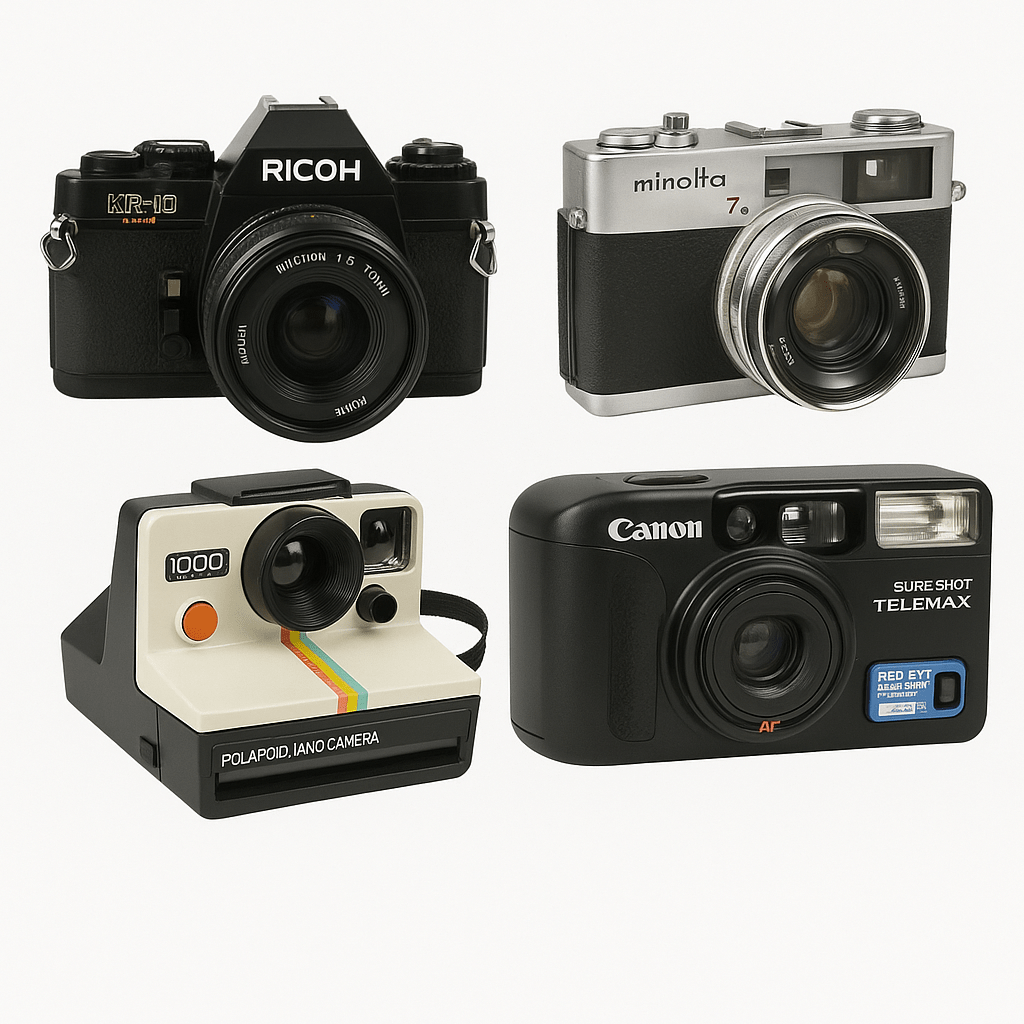
If you want a pocketable 35mm camera that does the thinking for you, the Canon Snappy AF is a fitting candidate. Canon introduced this budget-minded autofocus model in 1989, and it belongs to the family of simple analog cameras built for people who wanted a picture without any fuss, and it takes standard 35mm film with a 24 x 36 mm frame.
Canon's own manual describes it as a camera packed with features for simple, worry-free picture taking. In practice that means you point, press the shutter, and let the camera deal with focus, exposure, flash and film transport.
When nothing needs to be set, the photographer can pay attention to the people, the light and the moment. The trade-off is less control, so simple scenes and decent film matter.
Design Roots and Historical Background
A compact built to be easy
Canon kept the feature list short: motorised film transport, a built-in flash and active infrared focusing, all in a camera that dates from 1989.
The body measures 139.3 x 72.4 x 46.7 mm and weighs 315 g with its battery, according to the manual. It is small enough for a coat pocket or bag.
A lens-shutter design
Canon describes the camera as a 35mm lens-shutter model. There is no mirror and no interchangeable lens: the electronic shutter sits in the lens and also works as the aperture blades. The fixed Canon 35mm f/4.5 lens has three elements in three groups.
Key Technical Highlights
Autofocus and exposure
Focusing relies on Canon's active autofocus system, which sends out an infrared signal to judge distance. Exposure is controlled by a programmed electronic shutter. At ISO 100 it covers EV 10 to 17, from f/4.5 at 1/40 s to f/32 at 1/125 s.
The viewfinder is a reverse Galilean type with a yellow frame mark and a magnification of 0.42x. Film speed is set automatically from ISO 50 to 1600 for DX-coded film; film without a code is treated as ISO 100.
Flash, film handling and power
The built-in flash fires automatically in low light. Its range is 1.0 to 3.2 m with ISO 100 colour negative film, and up to 6.4 m with ISO 400. Recycling takes about 1.5 seconds with a new battery. The self-timer adds a 10-second delay.
Loading, advancing and rewinding are motorised. Rewinding takes roughly 20 seconds for a 24-exposure roll and starts at the end of the film, so you cannot rewind in the middle of a roll. Power comes from a single 6 V 2CR5 lithium battery.
- Lens: Canon 35mm f/4.5, three elements in three groups.
- Focus: active autofocus, 1.0 m to infinity.
- Exposure: programmed electronic shutter, EV 10-17 at ISO 100.
- Flash: automatic, up to 3.2 m at ISO 100 colour negative film.
- Weight: 315 g with battery; size 139.3 x 72.4 x 46.7 mm.
Modern-Day Use in 2026
Where the Snappy AF excels
The Snappy AF suits anyone who wants to try 35mm film without learning exposure settings. Focus, exposure, film speed and winding are all handled for you, so it is easy to hand over to a friend or keep in a bag for casual snapshots.
Use it for:
- Daylight travel and city snapshots.
- Family gatherings and parties where the automatic flash helps.
- A first roll of film for someone new to analog photography.
Practical shooting tips
- Stay at least 1.0 m from your subject so the autofocus can lock.
- Use film with a DX code so the camera sets the speed automatically.
- Keep people within flash range, about 3.2 m with ISO 100 film, when shooting indoors.
- Hold the camera steady and keep your fingers clear of the lens.
Buying and Maintenance Guide
What to check before buying used
Age affects rubber, foam and electronics, so go through a simple checklist before you commit:
- Look at the lens for haze, fungus, scratches or dust between elements.
- Open the back and inspect the light seals and foam for crumbling or stickiness.
- Fit a battery and confirm the shutter fires, the motor winds and the flash charges.
- Check the battery compartment contacts for corrosion.
- Make sure the viewfinder is clean and the self-timer works.
Ask whether a test roll has been shot and look at the results if you can: a fault in focus or exposure may only show on film.
Power and batteries
The Snappy AF uses one 6 V lithium battery of type 2CR5. Canon rates it at about 70 rolls of 24 exposures with 30% flash use. A few habits help:
- Fit a fresh 2CR5 before a trip rather than trusting an old one.
- Take the battery out if you store the camera for months.
- Check the contacts for dirt or corrosion before inserting a new cell.
Basic care and accessories
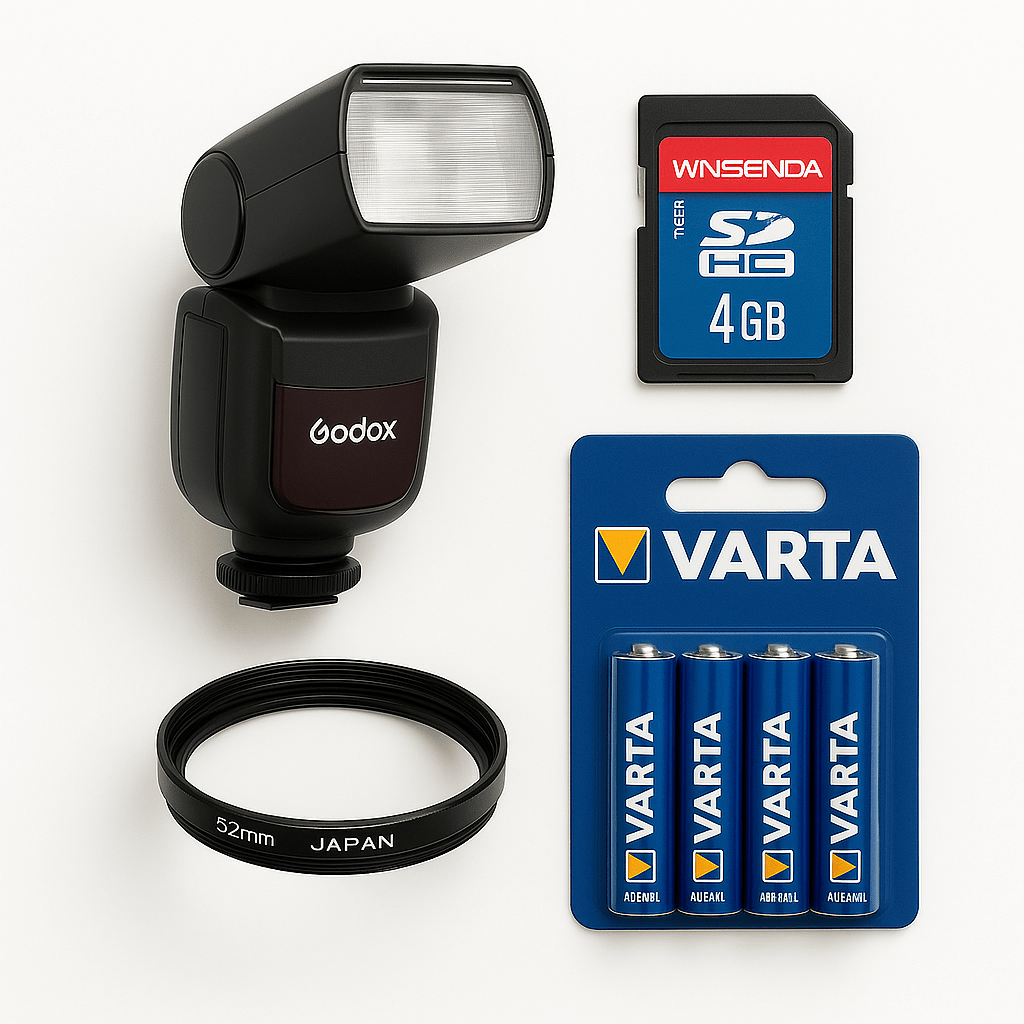
A few simple photography accessories keep a compact like this in good shape:
- A soft case or pouch to protect the lens from scratches.
- A microfibre cloth and a blower for the lens and the viewfinder.
- A spare 2CR5 battery for travel.
- Fresh 35mm film, stored away from heat.
Conclusion: Simple Film Photography
The Canon Snappy AF is a modest camera with a clear purpose. It combines a 35mm f/4.5 lens, active infrared autofocus, a programmed electronic shutter, automatic flash and motorised film handling in a body of 315 g.
If you want an easy way to shoot 35mm film, a well-checked Snappy AF is worth a look. Test the seals, battery contacts and flash, load a roll, and concentrate on the picture.
FAQs
What film does the Canon Snappy AF use? Standard 35mm film with a 24 x 36 mm frame. DX-coded film from ISO 50 to 1600 is set automatically.
What battery does the Canon Snappy AF need? It takes one 6 V lithium battery of type 2CR5. Canon rates it at about 70 rolls of 24 exposures when 30% of shots use flash.
How close can I focus with the Snappy AF? The focusing range starts at 1.0 m and runs to infinity, so keep your subject at least that far away.
Can I rewind the film halfway through a roll? No. Rewinding starts automatically at the end of the film and takes roughly 20 seconds for a 24-exposure roll. Mid-roll rewinding is not possible.
Where can I find the Canon Snappy AF manual? The original instruction manual is available as a free PDF download on this page, under the first photo.
Ready to explore cameras like the Snappy AF? Browse our curated selection of analog cameras and pair them with photography accessories at DutchThrift.com.
Sources: Canon Snappy AF instruction manual (PDF); Canon Snappy AF on camera-wiki.org, text licensed under GFDL 1.3.