


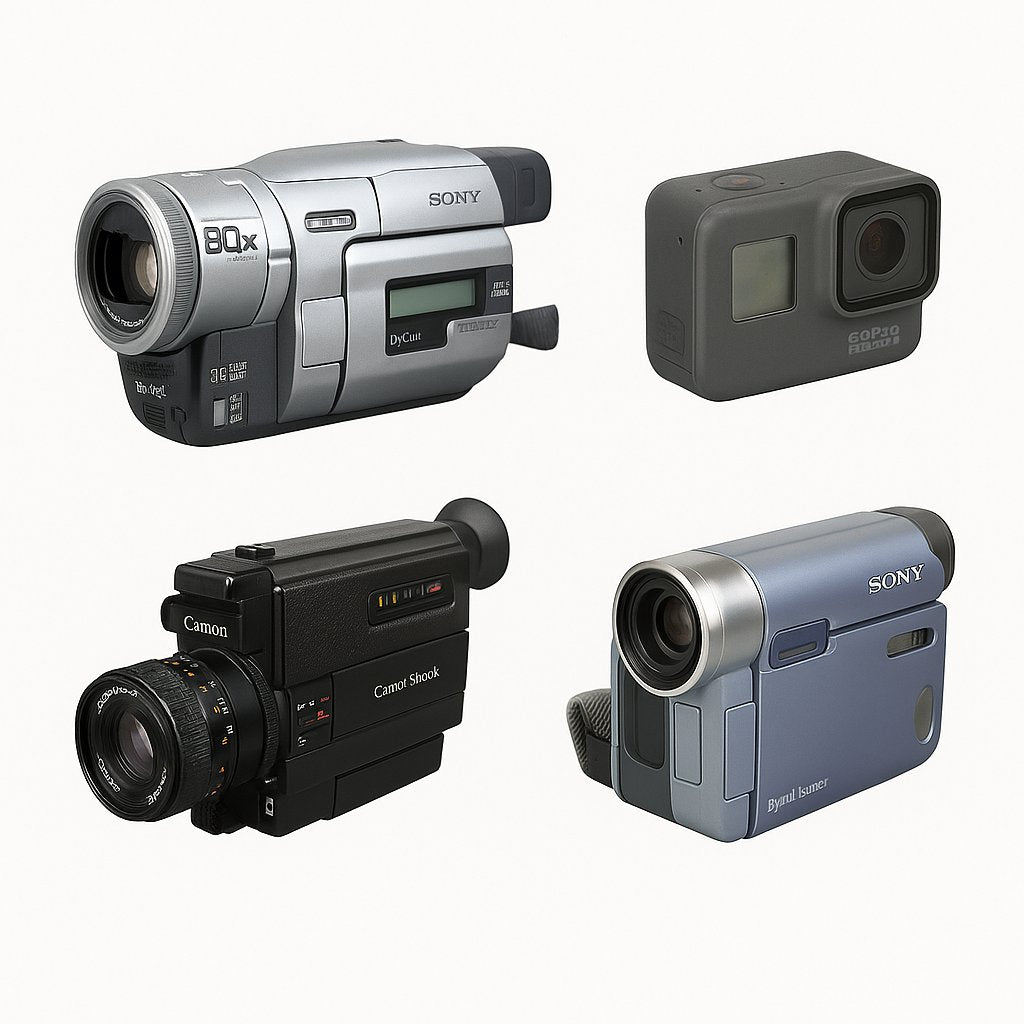

A Brief History of the Canon BP-8 Battery Pack
The Canon BP-8 battery pack arrived in the heyday of Hi8, when compact consumer camcorders were finally good enough to capture family archives, school projects and low-budget films with surprisingly rich detail. Canon’s UC and EX series Hi8 camcorders needed a slim, reliable and hot-swappable power source. The BP-8 became that workhorse block of energy.
Rather than rely on bulky AA holders or proprietary power grips, Canon built the BP-8 as a purpose-designed, slide-on pack. Its shape followed the body contours of popular Hi8 models, giving creators a low-profile, cable-free way to shoot longer and travel lighter. For many families, the BP-8 was invisible infrastructure: always there, seldom noticed, yet powering every milestone on tape.
I still remember the first time I held a Canon Hi8 camcorder: the quiet whir as the tape loaded, the small flip door hiding the BP-8, and the feeling that I finally had “real” video gear in my hands—long before memory cards and 4K menus.
Today, those same Hi8 cameras are being pulled from closets and thrift shelves as creators rediscover the texture of analog video. To make them truly usable in 2025 and beyond, the BP-8 is once again in the spotlight.
Technical Traits That Defined the BP-8
Form factor and fit
The Canon BP-8 was engineered as a dedicated pack for select UC and EX series camcorders. Its physical profile allowed it to lock seamlessly into the rear or side of the camera, maintaining balance and enabling shoulder or handheld shooting without awkward bulges or cables.

NiCd chemistry and performance
Inside, the BP-8 originally relied on nickel–cadmium (NiCd) cells. At the time, NiCd offered a robust balance of power density and durability, handling frequent charge/discharge cycles and temperature swings. These packs were designed to support continuous recording sessions, playback and in-camera tape shuttling without sudden drop-offs.
Decades later, however, most BP-8s suffer from reduced capacity, self-discharge and potential memory effects. They remain valuable shells and connectors, but rarely usable as-is without service.

Why the Canon BP-8 Still Matters in 2025
Preserving archives and family history
Across lofts and basements, boxes of Hi8 tapes hold irreplaceable footage. To digitise them with proper playback control and original colour, creators often return to the very camcorders that recorded them. A functional BP-8 makes that process far more reliable than juggling generic power supplies.
Analog aesthetics for modern creators
Beyond archiving, younger filmmakers, vloggers and experimental artists are embracing Hi8 for its grain, chroma noise and unique motion rendering. Running a classic UC or EX series camcorder on a restored BP-8 delivers that look with authentic handling and mobility—no desk-tethered PSU required.
Sustainability and circular gear culture
Rebuilding or recelling a BP-8 extends the life of existing hardware and reduces e‑waste. Instead of sending another plastic shell to landfill, you keep Canon’s original mechanical design in circulation, updated with modern cells. That fits perfectly into a circular approach to gear: reuse, repair, reimagine.
How to Use and Maintain Your BP-8
Pre-use inspection and safety
Before clicking any vintage battery into your camera, spend a moment on a basic health check. It protects both your camcorder and your footage.
- Inspect for cracked casing or corroded terminals before use.
- Use a smart charger that matches NiCd specifications.
- Rebuild only with correct voltage-equivalent modern cells.
- Label rebuilt packs with charge specs and date.
- ✅ Inspect battery terminals and latch condition.
- ⚙️ Expect aged internal cells—assume rebuilding is needed.
- 💡 Seek “recelled” or “refurbished” keywords in listings.
Charging and storage habits
If your BP-8 has been professionally rebuilt—often with NiMH or carefully selected lithium cells—respect the charger’s guidelines. Avoid fast chargers not specified for the chemistry inside the recelled pack, and never leave a charging pack unattended for long periods. For storage, keep the pack cool, dry and partially charged, especially if you only shoot a few times per year.
Buying a Canon BP-8 on the Second-Hand Market
What to look for in listings
On the used market, the BP-8’s value comes less from its original cells and more from its condition and service history. Look for clear photos of the contacts, latches and casing. Descriptions mentioning “tested,” “recelled,” or “refurbished” usually signal a more reliable pack than “untested, as-is.”
Because internal NiCd cells age even when unused, it is safer to assume that any untouched vintage pack is a candidate for rebuild. The upside: a pristine outer shell plus modern cells can be better than new in practical use.
Where to find compatible accessories
To get the most from a working BP-8, you will also want a compatible Canon charger, a stable Hi8 camcorder body and possibly capture hardware for digitising. Shops that specialise in second-hand photography accessories often stock chargers, power adapters and even capture solutions, while dedicated video communities can help track down rarer components.
Creative Workflows Empowered by the BP-8
Digitising and backup sessions
A solid BP-8 transforms tape transfers from a stressful race against a failing power brick into a calm, repeatable workflow. You can shuttle, pause, and re‑capture without fear of accidental shutdown mid‑tape. Many creators pair a recelled BP-8 with a capture card and a second-hand Hi8 deck or camcorder, turning old family tapes into future-proof digital files.
Field shooting with analog charm
For new projects, a dependable BP-8 lets you treat a Hi8 camcorder like any other field camera. Power it up, roam through city streets or forests, then drop the footage into a modern edit for hybrid looks alongside digital clips. The pack’s integrated design keeps your rig simple and cable-free.
Combining with your wider kit
If you already shoot film or use analog cameras, adding a Hi8 body and BP-8 to your bag complements that aesthetic with motion. The same patient, deliberate mindset that suits manual focus and film stocks translates beautifully to tape-based video.
Conclusion: A Sustainable Revival of Canon Craftsmanship
The Canon BP-8 battery pack is more than a relic from the Hi8 era. It is a bridge between yesterday’s family footage and today’s creative experiments. With thoughtful inspection, careful charging and, in many cases, a professional recell, this compact power brick can keep Canon’s UC and EX series camcorders alive for years to come.
Choosing to restore and reuse a BP-8 aligns with a broader shift toward sustainable gear habits—buying second-hand, repairing instead of replacing and celebrating the unique character of analog tools. Whether you are digitising a box of tapes or starting a new lo‑fi video project, a healthy BP-8 is a small but essential part of that story.
FAQs
Can the Canon BP-8 Battery Pack still hold a charge? Original NiCd cells inside most BP-8 packs rarely hold a meaningful charge after decades. Rebuilding the pack with modern NiMH or carefully specified lithium cells restores reliable capacity and runtime, often surpassing the practical performance of the original.
Is it safe to rebuild the Canon BP-8 at home? With proper soldering skills, knowledge of battery chemistry and access to quality cells, home rebuilding is possible. If you are unsure about wiring, insulation or safe charging curves, it is far better to use a professional recelling service to avoid voltage mismatches or thermal risks.
Does the BP-8 work with other Canon camcorders? The BP-8 was specifically designed for Canon UC and EX series Hi8 camcorders, providing the correct physical mount and electrical connections. It is not a universal Canon battery and should only be used with models that explicitly list BP-8 compatibility.
Where can I find accessories to pair with a working BP-8? Look to vintage video forums, specialist second-hand shops and curated photography accessories collections for original chargers, capture cards, brackets and rig components that complement a restored BP-8.
Ready to explore? Browse our second-hand videocameras, chargers and accessories to build your own sustainable Hi8 setup around the Canon BP-8.