



Introduction: The Cosina CT1 Super at a Glance
The Cosina CT1 Super is a straightforward single-lens reflex for film, built around the K bayonet. You set focus yourself, you set exposure yourself, and the camera only offers a meter to confirm your decision. It sits among the SLR film cameras for people who like to control every setting.
The shutter is purely mechanical, while the small cells inside serve the exposure meter alone. A flat battery therefore costs you the meter, not the whole camera.

Working with a fully manual SLR changes how a frame comes together. You read the light, pick an aperture and a shutter speed, turn the focusing ring until the split image lines up, and only then press the button. Every frame asks for a little attention.
Design Roots and Historical Background
Where it sits in the Cosina family
According to camera-wiki, this model is a development of the CT-1 and CT-1A that came before it. The big upgrade was a faster top shutter speed of 1/2000 s, and the body also gained a moulded plastic handgrip.
The CT1G is a close sibling that shares the same owner's manual. Its shutter stops at 1/1000 s and it has no self-timer.
Variants and rebadged siblings
A later production type looks slightly different, with a flatter prism housing and a small star after the model name. Camera-wiki reports no functional difference between the two. The same basic camera also turned up under other brand names. Revue sold it as the SC 4, Miranda as the MS-1 Super and Petri as the GX-1 Super, all without real changes. If that family interests you, our Petri GX-1 Super review covers one of them, and the Cosina CT7 Super guide covers another Cosina.

Key Technical Highlights
Shutter and exposure
The shutter is a metal blade design that travels vertically and runs mechanically. The manual lists B and speeds from 1 s to 1/2000 s, and flash synchronises at 1/125 s. No battery is involved in firing it.
Film speed can be set from ISO 25 to ISO 1600 in third-stop steps.
Metering and viewfinder
Metering is through the lens at full aperture and centre-weighted. Three LEDs in the finder guide you toward correct exposure, and the manual quotes a working range of EV3 to EV19 at ISO 100. The finder magnifies 0.86x and shows 93% of the frame, with a split-image focusing aid surrounded by a microprism ring.
Body and handling
The body measures 133 x 85 x 50 mm and weighs 410 g without a lens. A mechanical self-timer runs for roughly 10 s. There is no depth-of-field preview button, so you judge sharpness zones from the scale on the lens, or by experience.
- K-mount, manual focus and manual exposure
- Mechanical metal shutter, B and 1 s to 1/2000 s
- Flash sync at 1/125 s
- Centre-weighted TTL meter with three LEDs
- ISO 25 to 1600 and a 10 s mechanical self-timer
Modern-Day Use in 2026
Where the CT1 Super excels
Camera-wiki says some people see it as a more versatile entry-level SLR than the well-known Pentax K1000. That is an opinion rather than a measurement. Since the camera accepts K-mount glass, you can pair it with a wide choice of lenses.
Use it for:
- Learning exposure by balancing aperture, shutter speed and film speed yourself
- Travel and street photography with a small kit
- Telephoto portraits and details with an older manual lens
Practical shooting tips
- Keep a spare pair of cells in your bag, since only the meter relies on them.
- Use a fast shutter speed with long lenses when shooting handheld.
- Bracket important frames, because the three-LED meter gives guidance rather than exact readings.
Buying and Maintenance Guide
What to check before buying used
Inspect the moving parts first:
- Fire the shutter at every speed and listen for uneven or sluggish timing.
- Check that the meter LEDs respond when you change aperture or point at bright and dark scenes.
- Look at the light seals and mirror bumper for crumbling, stickiness or residue.
- Open the back and check that the shutter curtains are clean and undented.
- Look through the viewfinder for dust, haze or a dim, damaged focusing screen.
- Test the self-timer.
In a dark room, shine a torch through the lens to spot haze or fungus.
Power and batteries
Two SR44 or LR44 cells power the meter. A dead cell does not stop the shutter, but you lose the meter.
- Fit fresh cells of the same type when you start a roll.
- Remove the cells during long storage to prevent leakage.
Basic care and accessories
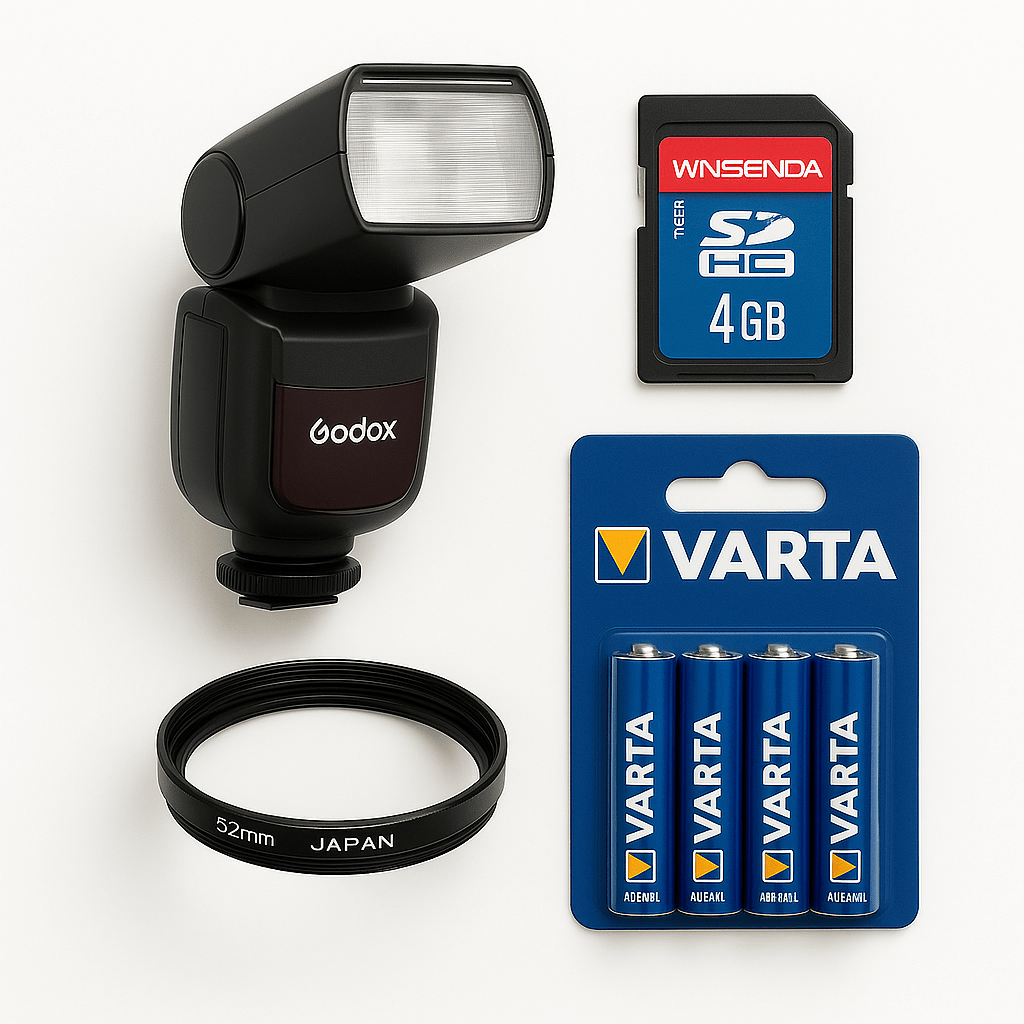
A few simple photography accessories keep an older SLR in good shape:
- A padded bag or strap to protect the body from knocks
- A blower and microfibre cloth for the lens and viewfinder
- Spare button cells for the meter
- A lens cap and a hood to reduce flare
Conclusion: Simple Tools, Honest Photos
The Cosina CT1 Super keeps things basic: a mechanical shutter, a modest LED meter and a bayonet that accepts a broad family of lenses. It improves on the earlier models, yet it has no depth-of-field preview.
For anyone who wants film photography with little electronics between them and the picture, a carefully checked example is worth considering.
FAQs
Does the Cosina CT1 Super need a battery? Only for the meter. The shutter is mechanical, and two SR44 or LR44 cells power the LED exposure meter.
What lenses fit the CT1 Super? It uses the K-mount bayonet, so lenses with that mount fit. Focus and aperture are both set by hand.
What is the difference between the CT1 Super and the CT1G? The CT1G tops out at 1/1000 s and has no self-timer. The CT1 Super reaches 1/2000 s and includes a mechanical self-timer.
Does it have depth-of-field preview? No. You need to estimate depth of field from the lens scale.
Where can I find the Cosina CT1 Super manual? The original instruction manual is available as a free PDF download on this page, under the first photo.
Ready to explore cameras like the CT1 Super? Browse our selection of SLR film cameras and wider analog cameras at DutchThrift.com.
Sources: original Cosina CT1 Super / CT1G instruction manual; Cosina CT1 Super on camera-wiki.org, text licensed under GFDL 1.3.