



Introduction: The Yashica M-II at a Glance
The Yashica M-II is a fixed-lens 35mm film camera that focuses with a rangefinder. Its lens is a 45mm f/2.8, and the shutter tops out at 1/1000 second. If you enjoy rangefinder cameras, this one offers a straightforward way to try the format without a big investment.
The M-II has relatives with a selenium light meter, namely the Yashica M and the Minister, so it is worth checking whether your own example carries one too. With a rangefinder you focus by lining up two images in the viewfinder, and you take care over every setting, so each frame feels like a decision you made.

Fixed-lens rangefinders tend to feel quieter and less obtrusive than a bulky film SLR, which suits candid everyday photography.
Design Roots and Historical Background
A branch of the Minister family
Start with the M-II itself: it is a variant of the Yashica M, and that model is a version of the earlier Yashica Minister. The Minister dates from 1960. Like the Yashica M, it carries a selenium meter in the body. Seen this way, the M-II is a later branch of one small rangefinder family rather than a stand-alone design.
Where the M-II fits
The M-II is a variant of that Yashica M. It keeps the f/2.8 lens speed of the Minister, and its shutter reaches 1/1000 second, while the related M tops out at 1/500 second. So the M-II gives up some lens speed for a faster top shutter setting.

Key Technical Highlights
Lens and shutter
The fixed lens is a 45mm f/2.8. The 1/1000 second top speed lets you keep the aperture wide on a bright day without overexposing, for example with a faster film.
Metering in the family
On the related Yashica M, metering is a hands-on job. In practice you read the meter first and only then choose aperture and shutter time yourself. A selenium cell makes its own small current from light, so it needs no battery. For the M-II itself, check whether your example has a meter and how it works.
The key specifications at a glance:
- Format: 35mm film, with a rangefinder for focusing.
- Lens: fixed 45mm f/2.8.
- Top shutter speed: 1/1000 second.
- Metering: the related M and Minister have a selenium meter; verify what your M-II offers.
- Family: a variant of the Yashica M, itself based on the 1960 Yashica Minister.
Modern-Day Use in 2026
Where the M-II excels
Today the M-II makes most sense as a learning tool and a walk-around camera. Aperture, speed and focus are all visible and tactile, which helps newcomers grasp how they relate.
Use it for:
- Street and everyday photography with a single 45mm view.
- Travel days where you want one small camera and no lens changes.
- Portraits in soft light at or near f/2.8.
- Learning manual exposure on inexpensive 35mm film.
Practical shooting tips
- Take a meter reading, set the lens rings, then focus; keep the order the same every time.
- Brace your elbows against your body at slow speeds; rangefinders lack mirror slap, but hands still shake.
- Note aperture and speed for each frame on the first roll, then compare with the results.
Buying and Maintenance Guide
What to check before buying used
A camera of this age has had time to collect problems, so go through it methodically:
- Look through the lens against a light for haze, fungus threads and cleaning marks.
- Check that the rangefinder patch is visible, bright and contrasty, and that it tracks as you focus.
- Fire every shutter speed and listen: slow speeds should sound clearly slower than fast ones.
- Turn the aperture and shutter rings through their whole range and feel for stiffness.
- If the camera has a light meter, expose it to bright light and watch whether it reacts.
- Open the back and inspect the light seals and the film channel for crumbling foam.
Light seals are cheap to replace, but a hazy lens or stuck shutter is a different matter. Weigh any repair against the price.
Power and film
The related Yashica M and Minister use a selenium meter, which needs no battery, so check whether your M-II has one too. If it does, a dead cell cannot be revived with fresh batteries.
- Carry a small handheld meter or a trusted phone app as a backup.
- Choose a general-purpose 35mm film in the middle of the speed range for the first roll.
- Store the camera in a dry place, out of direct sun.
Basic care and accessories
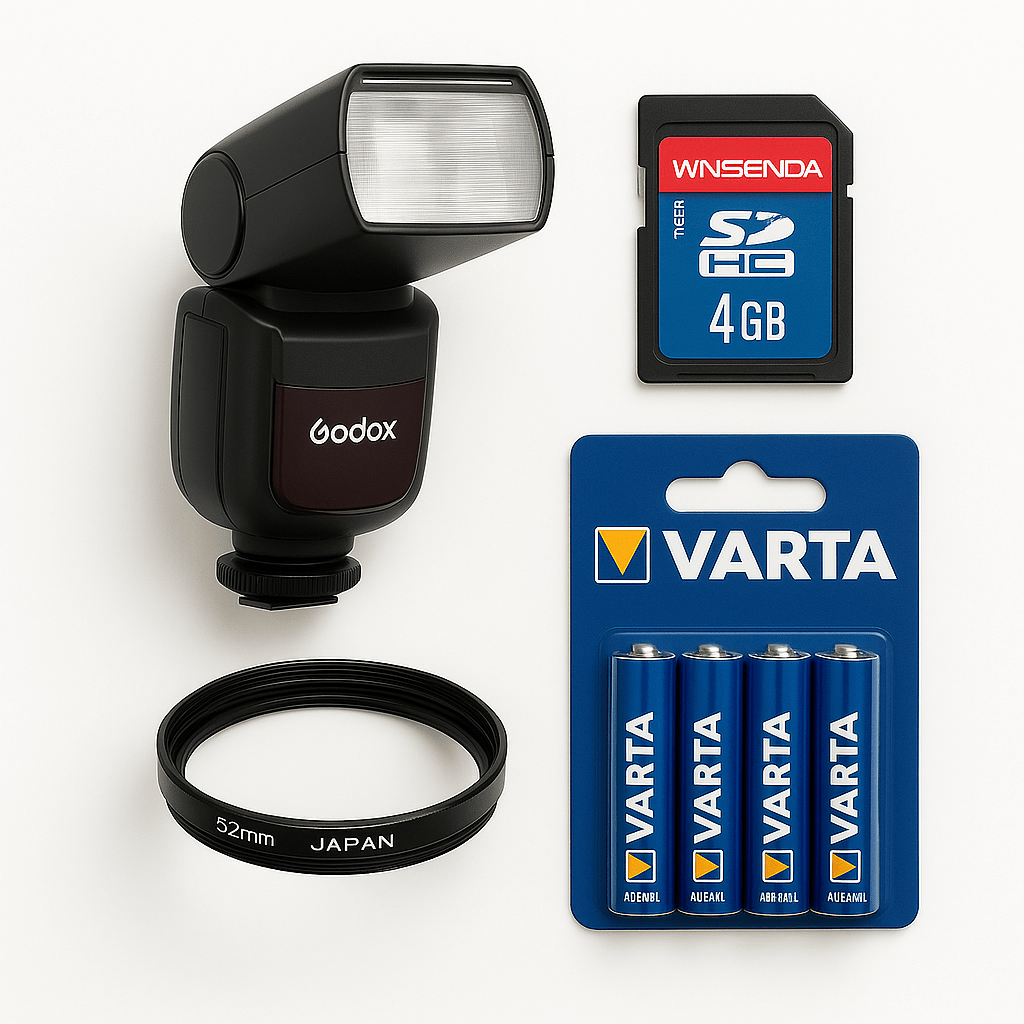
A few inexpensive photography accessories keep the camera in good shape:
- A lens cap, plus a clear filter if one fits, to protect the front element.
- A microfibre cloth and a blower for dust, used gently on glass and viewfinder windows.
- A padded pouch or case so the camera does not knock against keys and phones.
What to pay
On European marketplaces such as eBay, working examples are typically listed around €35–€55. Treat this as a guide: a hazy lens or doubtful shutter deserves a lower offer.
Conclusion: A Small Rangefinder with a Fast Shutter
The Yashica M-II sits in a family that starts with the 1960 Minister and passes through the faster-lensed Yashica M. Its mix of a 45mm f/2.8 lens and a 1/1000 second top speed gives it a practical character of its own.
Check the lens, rangefinder and shutter with care, keep a backup meter handy, and a good example can be a rewarding companion for years.
FAQs
What lens does the Yashica M-II have? It has a fixed 45mm f/2.8 lens, the same lens speed as the original Yashica Minister.
What is the fastest shutter speed of the M-II? The M-II shuts as fast as 1/1000 second. The related Yashica M reaches 1/500 second but has a faster f/1.9 lens.
Does the Yashica M-II need a battery? The related Yashica M and Minister have a selenium meter, which makes its own current from light and needs no battery. Check whether your M-II has such a meter, and verify it on a used example, because these cells age.
What should I check first when buying a used M-II? Start with the lens for haze or fungus, then the rangefinder patch, the shutter at every speed, any meter response and the light seals.
Ready to explore cameras like the Yashica M-II? Browse our rangefinder cameras, wander through the wider range of analog cameras and add a few photography accessories at DutchThrift.com.
Sources: Yashica M and Yashica Minister on camera-wiki.org, text licensed under GFDL 1.3; price range based on recent working examples listed on eBay in the Netherlands.