



Introduction: The Topcon RE Super at a Glance
The Topcon RE Super is a 35mm SLR film camera from the Tokyo Optical Company. It takes lenses with the Exakta bayonet and was manufactured between 1963 and 1971.
What makes it stand out is the metering. The exposure meter reads light through the lens itself, and this body is recorded as the first SLR to do so. Add a set of swappable viewfinder heads and a mechanical feel, and you get a camera that rewards careful, deliberate photography.

Shooting a mechanical SLR of this age is a slower, more tactile exercise than using a modern camera. You set the shutter speed by hand, judge the frame on a ground glass and wind on the film yourself. Many people find that this pace makes them think harder about each exposure.
Design Roots and Historical Background
A Tokyo Optical system camera
The RE Super is one of the SLR bodies produced by Tokyo Optical Company. By choosing the Exakta mount, the designers gave owners access to lenses in that fitting rather than a brand-new range.
Production began in 1963 and ended in 1971. Historically it counts as an important system camera, mainly because of its metering and its range of finder heads.
Metering through the lens arrives
The headline feature is the light measurement, taken through the lens and the first of its kind in any SLR. Instead of holding a separate meter, the photographer reads the exposure from the same image the lens produces.
You may also meet this camera under another label. In some markets it carried Beseler branding and went by the name Beseler Topcon Super D.

Key Technical Highlights
Metering through the lens
The light-sensitive CdS cells sit behind the reflex mirror, which has fine line-shaped slits that let some light reach them. The reading is a whole-scene average, so it does not favour the centre of the frame.
The meter works from 2 to 16 EV and handles film from ASA 25 up to ASA 1600. It does need a mercury-type battery.
Shutter, mirror and film handling
The focal plane shutter runs from one second to 1/1000 s, plus bulb. Electronic flash synchronises at 1/60 s. The mirror drops back immediately after exposure, the film is advanced with one stroke of the lever, and the frame counter resets itself. A self-timer can be set to fire after roughly 5 to 10 seconds.
Interchangeable finders
Several finder heads can be fitted: a waist-level finder, a pentaprism and a magnifying finder.
- Lens mount: Exakta bayonet
- Shutter: focal plane, 1 s to 1/1000 s plus bulb
- Flash synchronisation: 1/60 s
- Meter: CdS, 2 to 16 EV, ASA 25 to ASA 1600
- Extras: instant-return mirror, single-stroke wind, self-resetting counter, 5 to 10 second self-timer
Modern-Day Use in 2026
Where the RE Super excels
Today the RE Super suits photographers who want a fully manual SLR with history attached. Its meter can be checked independently, which makes it a fine camera for learning how aperture, shutter speed and film sensitivity interact.
Use it for:
- Deliberate street and travel photography on black-and-white or colour negative film.
- Landscape and architecture work, composed carefully on the ground glass.
- Collecting an early example of through-the-lens metering.
Practical shooting tips
- The metering is averaged: in high-contrast scenes, aim at a mid-tone area or adjust your reading.
- Keep flash shots at 1/60 s or slower.
- Test the meter on a roll of forgiving negative film and keep notes.
Buying and Maintenance Guide
What to check before buying used
A camera from the 1960s can still deliver excellent results, but age matters. Work through a short checklist and ask for clear photos of the mirror box and the inside of the body.
- Shine a torch through the lens and look for haze, fungus or scratches.
- Fire the shutter at all speeds, including bulb, and check that slow speeds sound consistent.
- Open the back and inspect the light seals and mirror foam for crumbling material.
- Check that the advance lever moves smoothly and the counter resets.
- Look into the finder for dust, mould or a dim, patchy image.
- Point the meter at bright and dark areas and compare it with a handheld meter.
Light seals are common wear items on cameras of this age. A shutter that hangs at slow speeds is a bigger concern.
Power and batteries
The metering circuit calls for a mercury-type battery. Check what the seller has fitted, and remember that an external meter or the sunny-16 rule can stand in.
- Remove any battery during storage to prevent leaks.
- If you fit a substitute, verify the meter against a reference reading.
Basic care and accessories
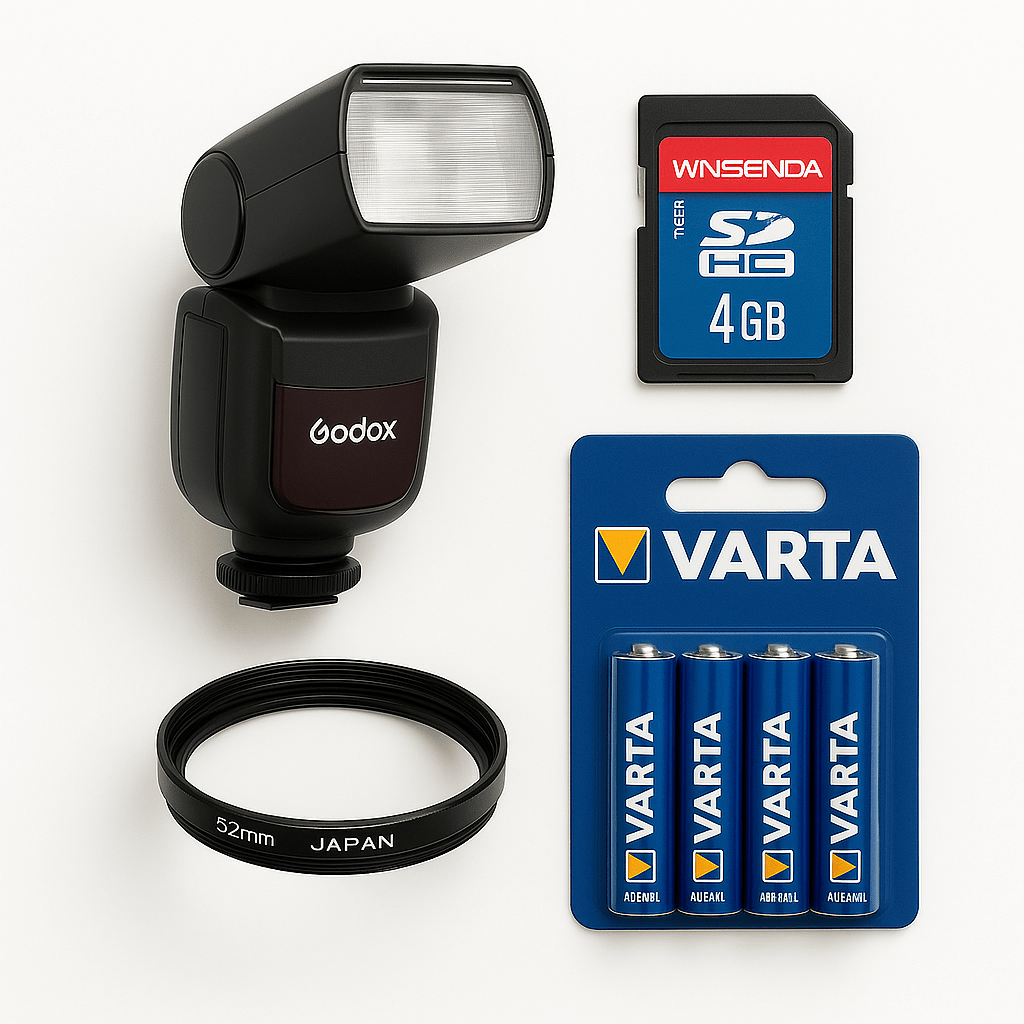
A few simple photography accessories keep the camera in good shape:
- A padded bag or case to protect the finder and lens.
- Lens caps and a hood to limit flare.
- A blower and microfibre cloth for dust; never wipe the mirror itself.
- A sturdy tripod for slow speeds and self-timer shots.
For other 35mm SLRs, see our guides to the Praktica B100, the Zenit E and the Petri GX-1 Super.
Conclusion: A Landmark Worth Shooting
The Topcon RE Super combines an Exakta lens mount and a pioneering through-the-lens meter in one mechanical package. Its shutter range, flash sync and choice of finders make it practical as well as interesting.
If you want a manual 35mm SLR with a story, a carefully checked example is a rewarding companion. Plan for the battery question.
FAQs
Who made the Topcon RE Super? Tokyo Optical Company built it. A Beseler-badged twin existed too, named Beseler Topcon Super D.
What lens mount does the Topcon RE Super use? It uses the Exakta bayonet mount, so lenses in that fitting can be attached.
Does the Topcon RE Super need a battery? The built-in meter needs a mercury-type battery. The shutter and film advance are mechanical, so the camera can still be used with an external meter.
What shutter speeds does it offer? The focal plane shutter covers 1 s to 1/1000 s plus bulb, with electronic flash synchronisation at 1/60 s.
Where can I find the Topcon RE Super manual? A copy of the original manual is available as a PDF download on this page.
Ready to explore cameras like the Topcon RE Super? Browse our curated SLR film cameras, discover more analog cameras and add suitable photography accessories at DutchThrift.com.
Sources: original instruction manual (scan); Topcon RE Super on camera-wiki.org, text licensed under GFDL 1.3.