



Introduction: The Olympus Trip AF at a Glance
The Olympus Trip AF is an automatic 35mm compact that belongs in the friendly corner of analog cameras where you simply frame, press and wind on. It pairs a Zuiko 35mm f/3.5 lens with an infrared autofocus system, an electronically programmed shutter and a pop-up flash, so nearly every decision is taken care of for you.
The name can cause confusion. Despite the Trip label, this is not the metal Trip 35. The Trip AF is a different camera, a mostly plastic everyday shooter. If you want a camera that asks very little of you, that is exactly its charm.

Simple automatic compacts like this reward a relaxed approach. Without dials to fiddle with, attention shifts to composition, light and timing.
Design Roots and Historical Background
A new Trip after the Trip 35
Think of the Trip AF as a budget-minded, largely plastic model from a Trip-branded family that Olympus built in 1984. The name was recycled, but the cameras were not updates of the earlier one: the Trip 35 was a separate, metal-bodied design that Olympus withdrew that same year, and the newcomers were engineered along different lines.
Simple autofocus, simple controls
The autofocus is a basic two-point system, and the manual describes it as an active infrared design. Winding is manual, using a thumbwheel on the back, and the frame counter resets automatically.

Key Technical Highlights
Lens and exposure
The lens is a Zuiko 35mm f/3.5 made up of four elements in three groups. The aperture range runs from f/3.5 to f/11, and the electronic programmed shutter selects speeds automatically between 1/85 and 1/250 s. The camera works both out for you.
Film speed is set with a manual selector covering ISO 100 to 400. The viewfinder is a bright frame finder with 0.5x magnification.
Flash, barrier and safeguards
The built-in flash pops up and needs roughly 6 seconds to recycle at normal temperature. A lens barrier opens and closes over the front, and the shutter locks while the barrier is closed, which protects the lens in a pocket or bag. The shutter release also locks when the subject is too dark for a good exposure, a cue to use the flash.
- Lens: Zuiko 35mm f/3.5, 4 elements in 3 groups
- Shutter: electronic, automatic 1/85 to 1/250 s
- Film speed: ISO 100 to 400, set manually
- Power: two 1.5V AAA batteries
- Size and weight: 115 x 66 x 43 mm, 210 grams
Modern-Day Use in 2026
Where the Trip AF excels
In 2026 the Trip AF suits anyone who wants an uncomplicated route into film. It is light at 210 grams, small enough for a coat pocket, and it asks for no metering, no focusing ring and no aperture choices.
Use it for:
- Everyday snapshots of friends, family and travel
- Street scenes where speed matters more than control
- Indoor shots at gatherings with the built-in flash
- Learning the basics of film before moving to manual cameras
Practical shooting tips
- Match the film speed selector to the film in the camera, within the ISO 100 to 400 range.
- Hold the camera steadily and keep your fingers clear of the lens and flash.
- Wait for the flash to recycle between pictures; about 6 seconds is normal.
- Heed the shutter lock in dim light and switch the flash on instead of forcing the shot.
Buying and Maintenance Guide
What to check before buying used
Condition varies widely on compacts of this age, so a careful inspection pays off.
- Check that the lens barrier opens and closes smoothly and fully.
- Look through the lens at a light source for haze, fungus or scratches.
- Confirm that the flash pops up, charges and fires.
- Inspect the battery compartment for corrosion and the contacts for damage.
- Test that the thumbwheel winds smoothly and the frame counter moves.
- Look for cracks in the plastic body and check the film door seals for light leaks.
Power and batteries
The Trip AF uses two 1.5V AAA batteries. The manual notes that the camera will not shoot if they are loaded incorrectly, and a green lamp in the viewfinder acts as a battery check.
- Use fresh AAA cells and replace both together.
- Remove the batteries if the camera will sit unused for a long period.
- Match the plus and minus markings carefully each time you load.
Basic care and accessories
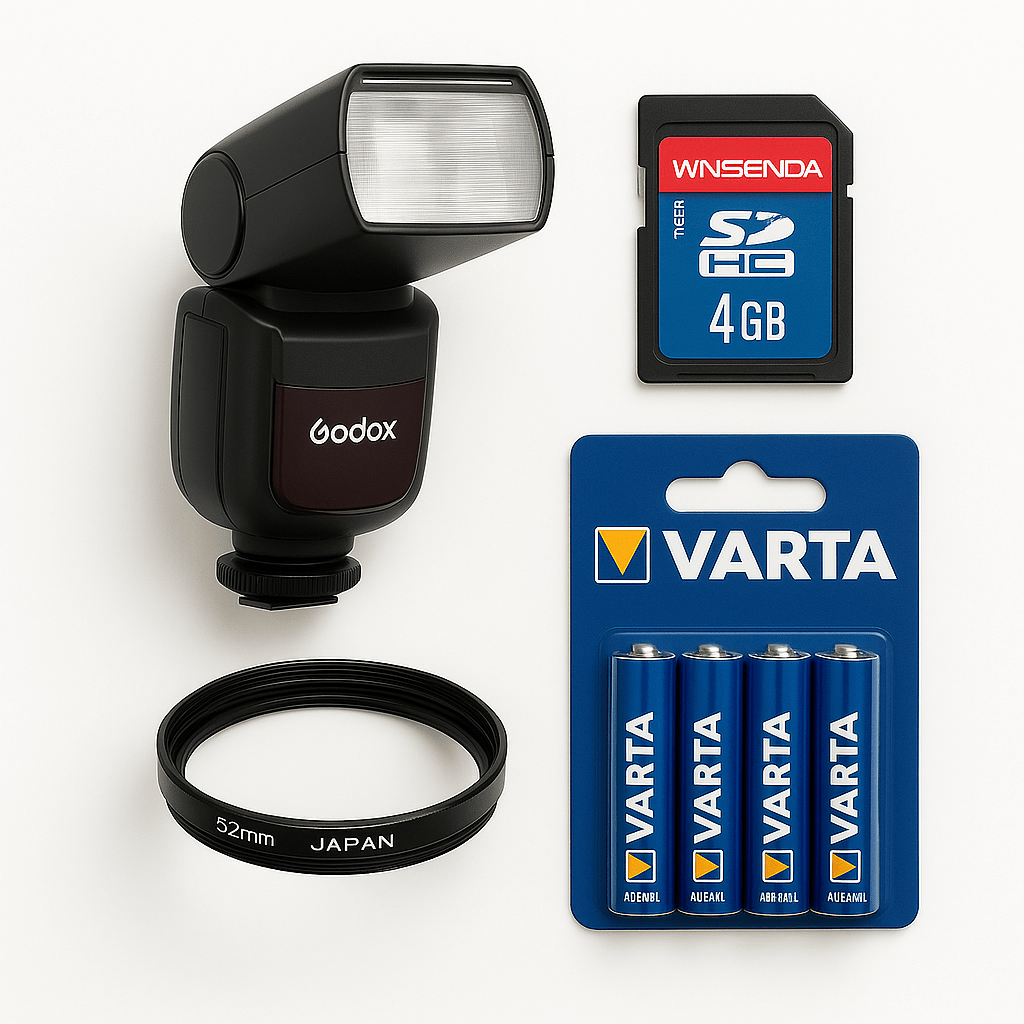
A few simple photography accessories will keep the camera in good shape:
- A soft pouch or small bag to protect the lens barrier and plastic body.
- A microfibre cloth and blower for the lens and viewfinder window.
- Spare AAA batteries kept in your bag.
Conclusion: Point, Press, Wind
The Olympus Trip AF is a modest camera with a clear purpose. Its Zuiko 35mm f/3.5 lens, automatic exposure, infrared autofocus and pop-up flash combine into a pocketable shooter that handles the routine decisions and leaves you to choose the moment.
It is not a precision tool, and it is not the metal Trip 35, but that is not the point. For an easy, low-stress introduction to 35mm film, a well-checked example is a friendly place to start.
FAQs
Is the Olympus Trip AF the same as the Trip 35? No, they are different cameras that simply share a name. The Trip AF is an inexpensive, mostly plastic autofocus compact from a Trip-branded series dating to 1984.
What batteries does the Olympus Trip AF use? It uses two 1.5V AAA batteries. A green lamp in the viewfinder helps you check them, and the camera will not shoot if they are loaded incorrectly.
What film speeds can I use? The manual selector covers ISO 100 to 400, so common colour and black-and-white films fit comfortably.
Does it have a built-in flash? Yes. The pop-up flash needs about 6 seconds to recycle at normal temperature, and the shutter release locks when the light is too dim.
Where can I find the Olympus Trip AF manual? The original instruction manual is available as a free PDF download on this page, under the first photo.
Ready to explore cameras like the Olympus Trip AF? Browse our analog cameras and our Olympus cameras, and add a few photography accessories at DutchThrift.com.
Sources: the original Olympus Trip AF instruction manual; Olympus Trip AF and Olympus Trip (autofocus) on camera-wiki.org, text licensed under GFDL 1.3.