



Introduction: The Pentax PC-50 at a Glance
The Pentax PC-50 is a lightweight plastic 35mm compact from the Pentax PC series, and it belongs firmly in the world of point-and-shoot film cameras. It pairs a 35mm f/4.5 lens with infrared autofocus, a fixed shutter speed and a built-in flash, so almost every decision is made for you. You load a roll, frame the picture and press the button.
With no dials to set, it is an easy way to start with analog film. Weighing about 190 g without batteries and measuring 126 x 73 x 49 mm, it slips into a coat pocket or a small bag without fuss.

Automatic compacts like this one reward a relaxed approach. When the camera handles focus, exposure and film transport, your attention can go to composition, light and the moment itself.
Design Roots and Historical Background
A member of the Pentax PC series
The PC-50 is part of the Pentax PC series of 35mm compacts. According to camera-wiki, it is a lightweight plastic point-and-shoot, and it was manufactured in China.
A PC-50 Date variant also exists. The two are covered in the same manual, and the main differences are the date imprinting feature, a slightly deeper body and a small difference in weight.
Built around automation
Everything about the layout points to ease of use. Film loading is automatic, the flash decides for itself when it is needed, and the lens is a simple three-element design.

Key Technical Highlights
Lens, focusing and exposure
The lens is a Pentax 35mm f/4.5 built from three elements in three groups. Focusing uses active infrared autofocus with focus-lock, working from roughly 1.2 m to infinity.
The shutter is fixed at 1/125 s, so exposure is managed through the aperture. The camera sets it automatically: f/4.5 in low light, f/8 with ISO 100 or 200 film and f/16 with ISO 400 film.
Film, flash and viewfinder
The PC-50 reads DX codes to set film speed, supporting 35mm DX-coded film from ISO 100 to ISO 400. Film without DX coding is treated as ISO 100. Loading is automatic: close the back cover, press the shutter button and the camera winds on to the first frame. Winding and rewinding are automatic too.
The built-in flash fires automatically in low light and needs about 6 seconds to recharge. The viewfinder is an Albada-type bright-frame finder, and a self-timer with a delay of about 10 seconds can be cancelled after you start it.
- Lens: Pentax 35mm f/4.5, three elements in three groups.
- Focus: active infrared autofocus with focus-lock, about 1.2 m to infinity.
- Shutter: fixed 1/125 s with automatic aperture control.
- Film: 35mm DX-coded, ISO 100 to 400, with automatic loading, winding and rewinding.
- Size and weight: 126 x 73 x 49 mm, about 190 g without batteries.
Modern-Day Use in 2026
Where the PC-50 excels
The PC-50 suits anyone who wants film photography with minimal setup. Automatic loading removes one of the more intimidating steps for beginners, and the fixed shutter and automatic aperture mean there is nothing to misset.
Use it for:
- Everyday snapshots of friends, family and travel.
- Learning how film behaves before moving to a manual camera.
- A lightweight second camera that fits a small bag.
- Casual flash portraits in dim indoor light.
Practical shooting tips
- Choose ISO 100 or 200 film for bright days and ISO 400 when light is mixed or fading.
- Use focus-lock for off-centre subjects: aim, half-press, recompose, then shoot.
- Stay within the autofocus range and keep subjects farther away than about 1.2 m.
- Wait for the flash to recharge, about 6 seconds, before taking the next flash photo.
Buying and Maintenance Guide
What to check before buying used
Plastic compacts are often cheap, but condition varies a lot. A few minutes of checking can save you from a camera that only looks fine in photos. Work through this list when you inspect one:
- Look through the lens for scratches, haze, dust or fungus.
- Open the battery compartment and look for corrosion on the contacts.
- Insert batteries and check that the camera powers up and the flash charges.
- Press the shutter button and listen for a smooth shutter and automatic film transport.
- Test the viewfinder, the self-timer and the back cover latch.
If possible, run a short test roll, since electronic compacts can fail in ways a dry test does not show.
Power, batteries and film
The PC-50 uses two 1.5 V AA alkaline batteries. Ni-Cd and manganese batteries are not usable, so stick with standard alkaline cells. The PC-50 Date variant also takes a 3 V CR2025 lithium battery for its date imprinting.
- Fit fresh AA alkaline batteries and remove them if you store the camera for a long time.
- Use DX-coded 35mm film from ISO 100 to 400; non-DX film is treated as ISO 100.
- On a Date model, check the CR2025 battery separately.
Basic care and accessories
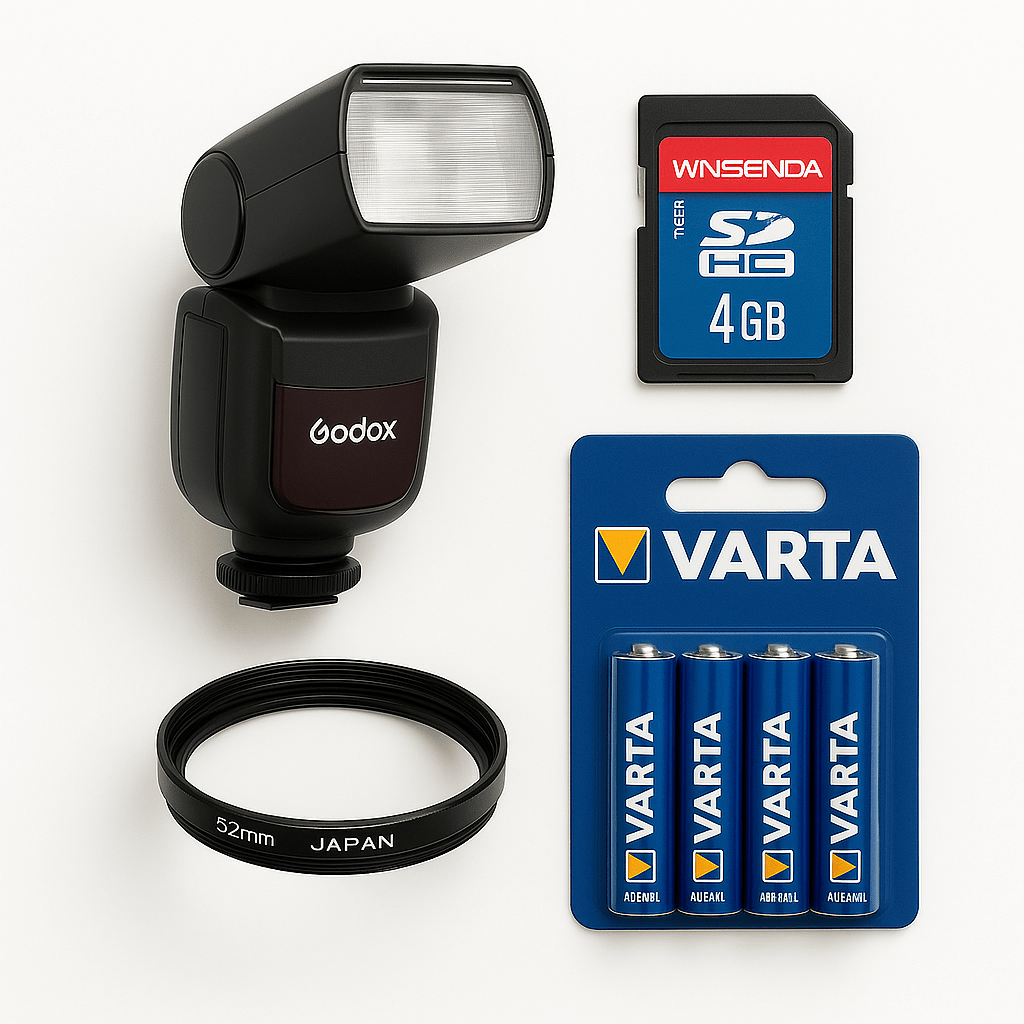
A few photography accessories make everyday use easier:
- A soft pouch or small camera bag to protect the body from scratches and knocks.
- A microfiber cloth and a blower for the lens and flash window.
- Spare AA alkaline batteries kept in your bag.
What to pay
On European marketplaces such as eBay, working examples are typically listed around €25–€40. Condition and the Date version can move a price, so compare several listings.
Conclusion: Easy Film Photography
The Pentax PC-50 is a straightforward, lightweight 35mm compact. Its 35mm f/4.5 lens, infrared autofocus, fixed 1/125 s shutter and automatic film handling keep the process simple, while the built-in flash helps when the light fades.
If you want an uncomplicated route into film, check the battery compartment, the lens and the flash, load a roll of DX-coded film and start shooting. The PC-50 asks very little of you, and that is exactly its appeal.
FAQs
How does the PC-50 focus? It uses active infrared autofocus with focus-lock, covering a range from roughly 1.2 m to infinity.
What batteries does the Pentax PC-50 use? It uses two 1.5 V AA alkaline batteries. Ni-Cd and manganese batteries are not usable.
Which film can I use in the PC-50? The camera accepts 35mm DX-coded film from ISO 100 to 400. Film without DX coding is treated as ISO 100.
Where can I find the Pentax PC-50 manual? The original instruction manual is available as a free PDF download on this page, under the first photo.
Ready to explore cameras like the Pentax PC-50? Browse our point-and-shoot cameras, discover more analog cameras and find useful photography accessories at DutchThrift.com.
Sources: the original Pentax PC-50 and PC-50 Date instruction manual; Pentax PC-50 (Date) on camera-wiki.org, text licensed under GFDL 1.3; price range based on recent eBay listings of working examples.